


The other day, I was accused of using AI. He also accused me of being a Russian agent of misinformation (I wish!). He’s a troll, so the accusation didn’t bother me. Except it kinda did. Just not for the reason you might think.
What bothers me is that he’s not the first person to accuse me of using AI. Not that he was wrong, I do use it. I also use a computer, the internet, and search engines, and Word checks my spelling and grammar.
What am I supposed to do, write on parchment I’ve made myself using only information I’ve gotten by directly interviewing experts?

The number of people who have AI derangement syndrome is astounding. If they aren’t complaining that AI will destroy the world or take all our jobs, they’re complaining that it’s making us lazy or worse.
Note: If the concern is jobs, read this. Spoiler alert: the worry is exaggerated.
Here are two recent examples:
According to the first story, “GPS ruined our sense of direction. Search engines weaken our memory. AI, scientists warn, could do the same to everything from creativity to critical thinking.”
I have no doubt it’s true.
If you let AI do everything for you. However, if you use it intelligently – for research, editing, feedback, etc. - then it’s simply a tool.
I remember when technical advances were to be praised. Now it seems we’ve become a society of Luddites. Or have we?
This isn’t the first time people have argued that a new technology was going to make people dumber. Let’s look at some of the big ones:
Writing - Socrates worried that it would weaken memory and create the illusion of knowledge instead of true understanding.
Printing Press - Critics feared that it would result in a flood of cheap books which would spread misinformation, and that, without proper guidance, would lead to shallow reading and heretical ideas.
Newspapers - Jean-Jacques Rousseau (among others) were concerned that they would encourage superficial thinking, gossip, and distract from serious intellectual life.
Novels - Moralists and educators in the 18th–19th centuries believed that “trivial” reading would weaken discipline, especially among youth and women, and blur reality vs fantasy.
Calculators - Educators in the 20th century thought students would lose basic arithmetic skills and become mentally lazy.
Radio - Early 20th-century commentators worried that passive listening would replace reading and critical thought and that families would become less engaged with each other.
Television - See “Radio” above, but add that it would shorten attention spans and turn public discourse into a shallow spectacle.
Video Games - Parents, psychologists, and policymakers since the 1980s argue that it leads to addiction, reduced attention span, and less real-world socialization.
Internet / Search Engines - Critics were concerned that constant access to information reduces deep thinking and memory (“outsourcing the brain”). Sound familiar?
Smartphones / Social Media - Researchers, educators, and public figures today argue that they shortened attention spans, fuel dopamine-driven distraction, reduced face-to-face interaction, and lead to dependency.
I’m old enough to remember the last four, and I’d argue that the concerns around TV, video games, and search engines were overblown.
The jury is still out on smartphones and social media, as you’ve no doubt noticed based on the number of governments looking to ban them. I wouldn’t give a 16-year-old a bottle of whiskey, and I’m not sure giving them access to social media is any better.
That doesn’t mean that every new advance will ruin people, though. Or that sometimes there aren’t legitimate concerns. However, history also shows that people tend to adapt, and new tools often shift intelligence rather than simply degrading it.
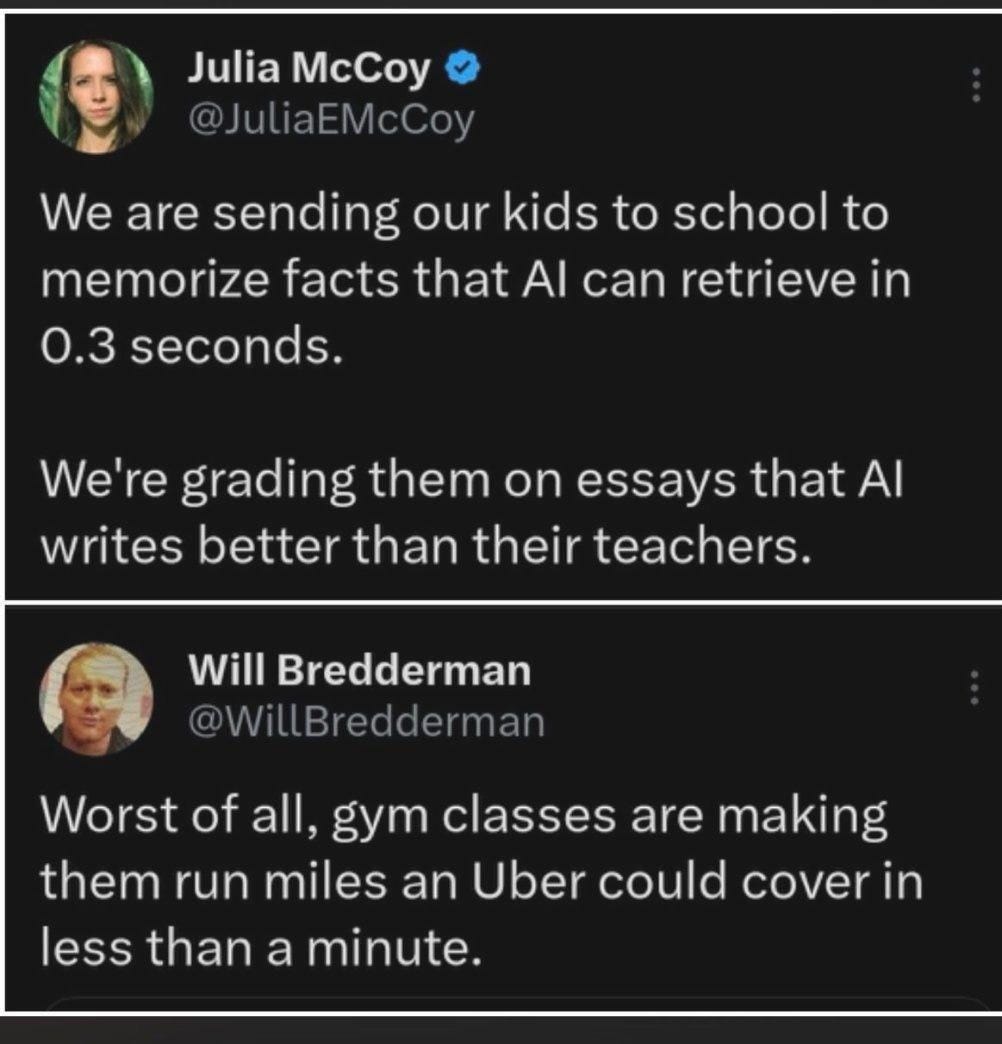
What usually comes down to is this: if you’re using AI to do your writing, or if you believe everything it says, you’re heading for trouble. Use it wisely, though – and with a healthy dose of skepticism – and you’ll be just fine.
At the end of the day, it comes down to who is doing your thinking, you or AI, and we each make that decision for ourselves.
If you’re letting AI do your thinking, maybe you weren’t all that smart to begin with.
Phil is a freelance writer, Canadian Navy veteran, and classical liberal. He has lived and worked in both Canada and the United States and currently resides in Vancouver, British Columbia where he writes on politics, individual rights, free speech, and anything else that catches his fancy.
As you may have picked up from this article he’s now trying his hand at humor. You can find some of what he finds funny here.
If you enjoyed this article, please consider sharing your thoughts in the comments, subscribing, or even buying him a coffee if you’re feeling generous and felt that this was a particularly enjoyable article.
Wrong Speak is a free-expression platform that allows varying viewpoints. All views expressed in this article are the author’s own.

I have found that most of life has been a "me" problem.
My bicycle shortened distances I needed to walk. My scooter shortened that even more even as it gave me more time available at each end. Not using that time to exercise, that was on me.
Same with thinking!
It is a 'you' problem, yet most people dont see it not even when you show them. The technical and psychological 'magic' is going past them.
And if 'we' cant communicate it, it means that the 'you' problem isn't really holding water.
The marketing/propaganda sells AI as intelligent smart a handy dandy tool that gives you an advantage on your competitor.
The first lie that people believe they take as truth. And to show them its a lie is very difficult.
Its like telling a devote religious person that there is a possibility that the thing they believe is not based on a fact, but on a story written several generations later, and printed again several generations later. As writing and the printing press technology were only invented many years after it supposedly happened.
Todays general public is not a tech incrowd, its just people who hold a magical wand and call it a smartphone.
How to really explain things to them is very very difficult as they dont have the technical background, some have, but thats less then 1%