


If you spend much time on “Canadian Twitter,” you may have noticed a recent news item highlighting that the population of Canada declined by 76,068 people during the third quarter of 2025.
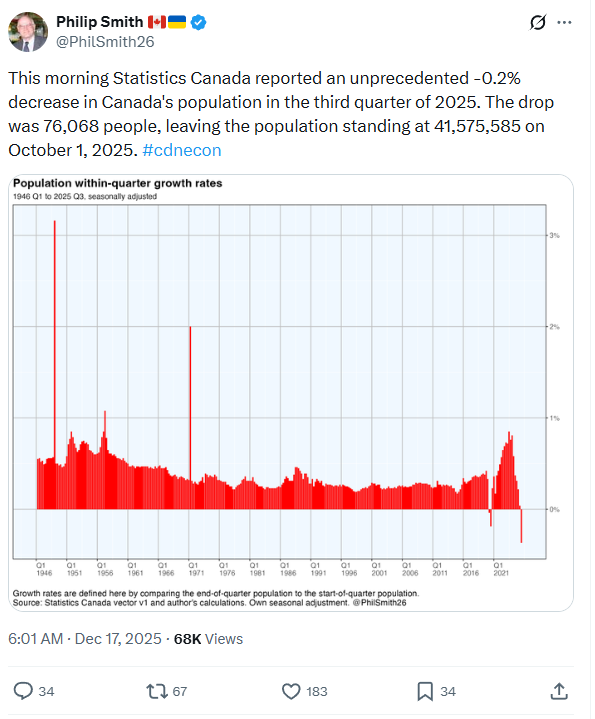
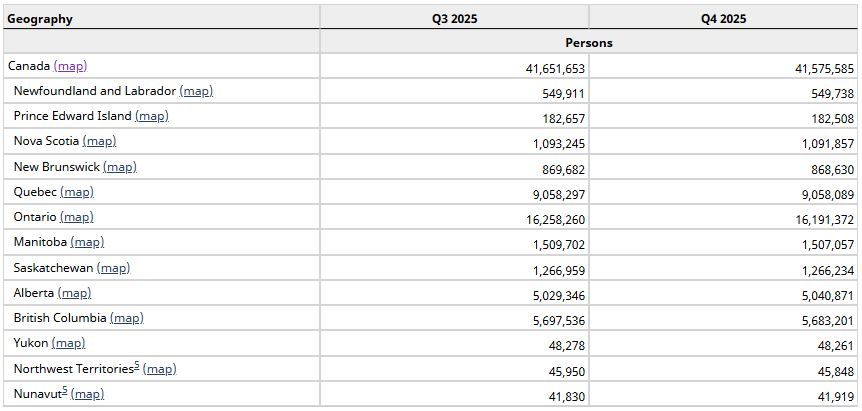
76,000 people doesn’t sound like a lot, and it isn’t, however it is largely being spun by supporters of high immigration as terrible news for the economy.


Is it though?
What seems to be understated or outright ignored is that Canada did not experience immigration during the Trudeau years, but rather a program of mass immigration, as shown by this graph.
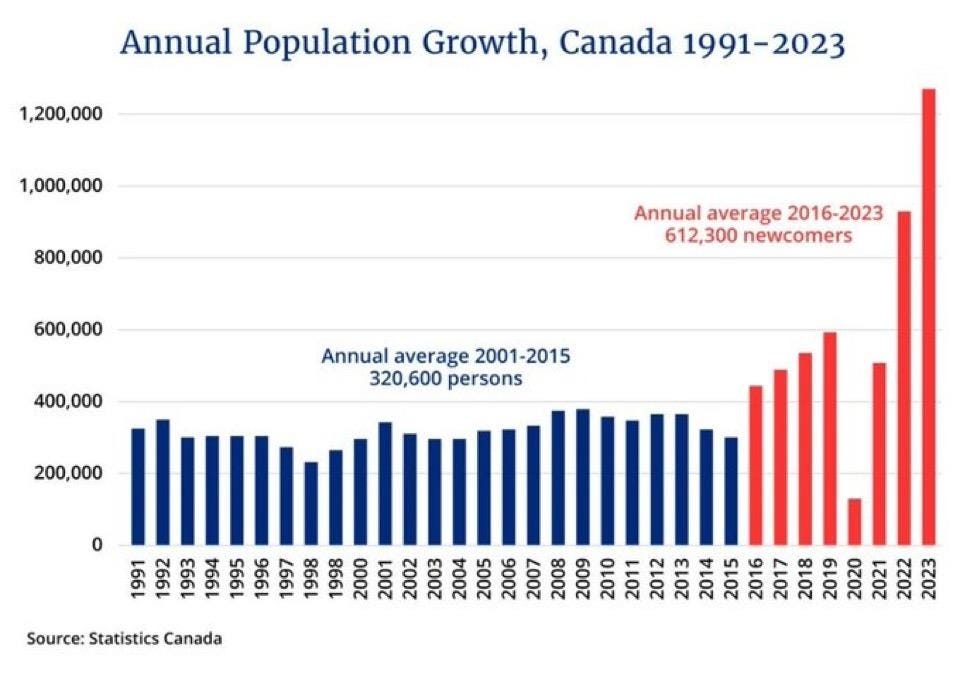
Note: While I have not been able to find a more recent version of this graph, Stats Canada data – if I’m reading it correctly – appears to show that 880k immigrants and non-permanent residents entered the county in 2024, down from 1.26M in 2023.
One of the results of this program of mass immigration was an exacerbated housing crisis, a strain on the healthcare system, and stagnant wages.
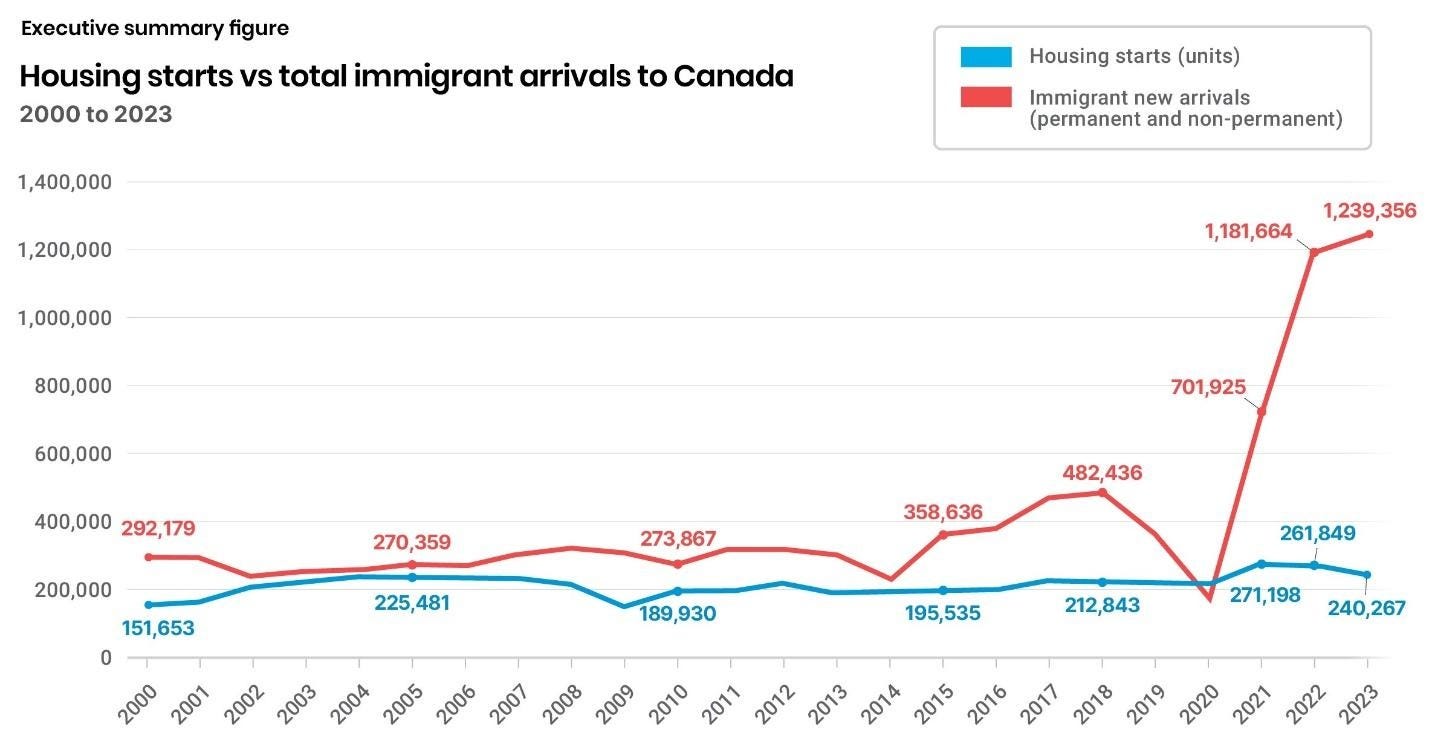
We know immigration has been out of control because one of the reasons the Liberals were able to win the 2025 election – aside from dumping the very unpopular Trudeau – was that they cut the legs out from under the Conservatives by promising to end Trudeau’s wildly unpopular mass immigration program.
If the population decline is examined with the understanding that immigration has been too high for a decade, the decline should be seen not as a terrible turn of events, but rather as a planned reduction, a “blowing off of steam” that had to happen if Canadians did not want to see the system blow up entirely.
Don’t let the door hit you on the…
Even the more measured takes, such as this one, fail once we dig into the details.

The decline is not caused by citizens emigrating to other countries for better opportunities, but rather by a decline in non-permanent residents. In other words, visa holders.
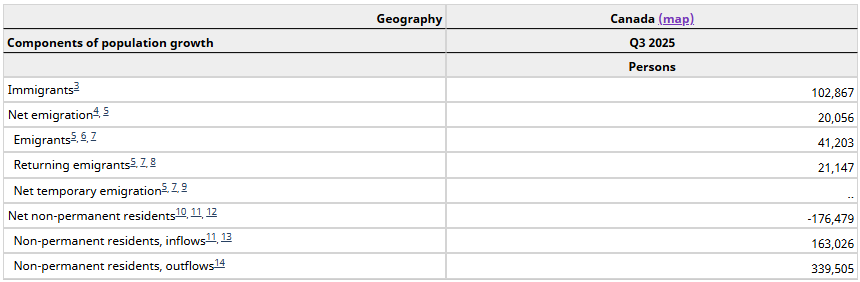
Note: if the numbers don’t add up, and they seem not to, blame Stats Canada, not me. A better – or frankly, any – explanation of how the various charts relate would have made this exercise much easier.
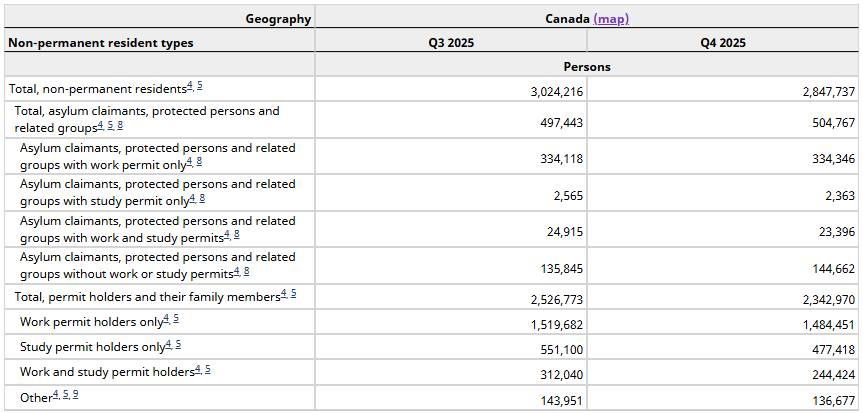
Lest anyone frame this as Canada becoming an unwelcoming place for immigrants, let me point out that the country did allow 102,867 new immigrants in the third quarter, a number that is higher than the quarterly average since 2015 (87,518), and while the number of non-permanent residents has declined, it was not due to a the end of Canada’s generous asylum policies. The number of asylum claimants rose by 7,324 overall and by 8,817 in the “asylum claimants without work or study permits” category (i.e., people who receive benefits but do not contribute to the economy – my apologies for putting this bluntly).
The majority of outflows were work permit holders (-35,231) and study permit holders (-73,682).
What does this mean for the economy?
This is difficult to determine because there are too many questions to which we don’t have answers:
Did everyone who left have a job?
What did these jobs contribute to the economy?
How much did these people spend in Canada, and how much did they send “home?”
Will permanent Canadian residents want the jobs that have been vacated?
I’m not an economist, so I’m going to have to make some assumptions.
On second thought, that might mean I am an economist because that’s typically what they do as well.
The easiest approach is to assume that their contribution to the economy is “average.” However, even then, we are left with the question: average for the workforce or average for the population? Let’s do both. We’ll also assume that no one takes the jobs being vacated, and none of the people who left were sending any money home:
They were all employed - If this was the case, 76,068 represents 0.35% of the 21.5 million labor force. Canada’s GDP is US$2.39 trillion. In this scenario, GDP would be reduced by US$8.365 billion.
They were representative of the broader Canadian population – 76,068 represents 0.183% of Canada’s total population (41,575,585). In this scenario, GDP would be reduced by US$4.374 billion.
Both are large numbers. Until you consider them from a per capita standpoint, then they become US$201.20 per person and US$105.20 per person.
Not great, but hardly crippling.
And let’s be honest, my assumptions were overly generous and do not take into consideration the benefits of a slight decrease in population (ex. housing, wages, employment).
During the Trudeau years, the population grew by over 6 million. That’s roughly 15–18%. The most recent comprehensive data (2021 census) shows 23% of the Canadian population are foreign-born, or almost 1 in 4. The 76,068 people that Canada lost during the third quarter represent approximately 0.2% of the country’s population.
I don’t think Canada is suddenly in danger of turning into Japan or South Korea. If you get the impression that I see this as a big “nothing burger,” well done, you’ve been paying attention.
And if you’re still not convinced, I saved the best for last. StatCan’s methodology is to treat the expiration of permits as departures regardless of actual exit.
In other words, there’s no proof that any of these people even left. If only the Canadian government took the same approach to collecting taxes.
Phil is a freelance writer, Canadian Navy veteran, and classical liberal. He has lived and worked in both Canada and the United States and currently resides in Vancouver, British Columbia where he writes on politics, individual rights, free speech, and anything else that catches his fancy.
As you may have picked up from this article he’s now trying his hand at humor. You can find some of what he finds funny here.
If you enjoyed this article please consider sharing your thoughts in the comments, subscribing, or even buying him a coffee if you’re feeling generous and felt that this was a particularly enjoyable article. Your attention, participation, and support really make a difference to us.
Also, a ‘like’ really helps the Substack algorithm find us. And we’d be most grateful if you would share this piece to help the Substack grow.
Wrong Speak is a free-expression platform that allows varying viewpoints. All views expressed in this article are the author’s own.

The West OUGHT to be unwelcoming to immigrants from cultures and ideologies whose stated purpose is the overthrow of the West. Any other policy is suicidal.
I think the graphs are popular because it plays well politically for the government. It looks like they are reducing immigration levels while still keeping them historically high. The people that feel immigration needs to be higher aren't going to leave the Liberals for the conservatives who would reduce the levels further.
I agree with your assessment that this decline is a nothing burger and a blowing off steam. The Carney government is playing all sides to hold onto the farther left but reach out to entice moderate conservatives.
It will be interesting to see how the policies go once he attains a likely majority. Does he modify past stated positions or does he revert back to them.