


What were the greatest crimes of the 20th century in the United States? We usually think of crimes as isolated acts — murders, frauds, or mass shootings — not as long-term institutional failures. But the latter can inflict far greater harm, affecting millions of people for generations.
When I asked ChatGPT what it considered the greatest crimes of the 20th century, it named two:
Japanese American Internment (1942–1945)
Crime: 120,000 Americans of Japanese ancestry were forcibly removed from their homes and imprisoned during World War II.
Reason given: “National security.”
Impact: Loss of homes, businesses, and civil rights — later acknowledged as unconstitutional and racist.
The Vietnam War (1955–1975)
Crime (in moral terms): Civilian massacres such as My Lai, the use of chemical weapons like Agent Orange, and millions of Vietnamese deaths.
U.S. casualties: ~58,000 soldiers killed.
Impact: Deep political divisions and loss of public trust in government.

Both were massive moral failures. But there is a more insidious, slow-moving crime that dwarfs them in scope — one that has touched nearly every American life and continues to shape the nation’s health and economy.
That crime is the U.S. government’s Food Pyramid.
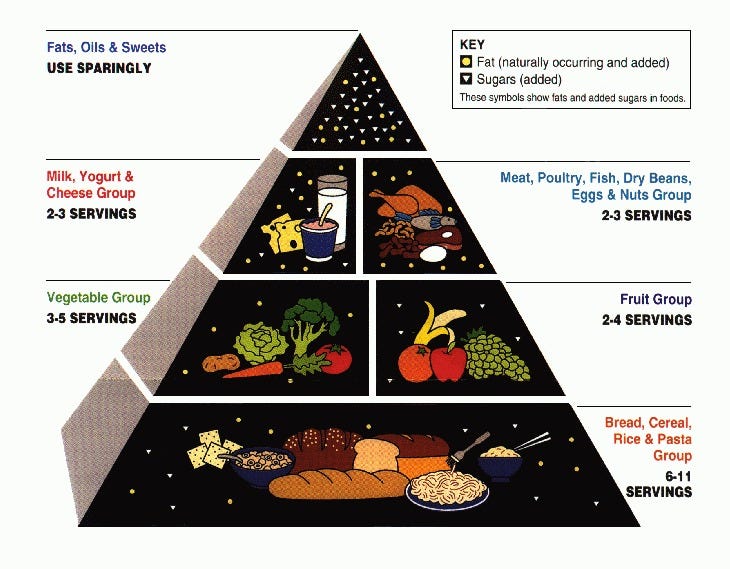
The Birth of a Misguided Guide
The USDA Food Guide Pyramid, introduced in 1992, portrayed a healthy diet as one built primarily on grains — 6 to 11 servings per day — with fats and oils at the very top, to be used “sparingly.” Meats and dairy were minimized, while bread, cereal, rice, and pasta were elevated as the foundation of health.
The pyramid’s message was clear: carbohydrates were good, and fats were bad. But this message was scientifically wrong even at the time.
Human metabolism evolved to run primarily on fat, with carbohydrates playing a small role. For most of human history, people ate meat, vegetables, nuts, and berries. Agriculture and modern food processing introduced large quantities of refined carbohydrates that the human body isn’t designed to handle. When carbohydrate intake is high, the body burns sugar for energy and stores fat instead of using it — leading to weight gain, insulin resistance, and chronic metabolic disease.
The Consequences: A Nation Grows Sick
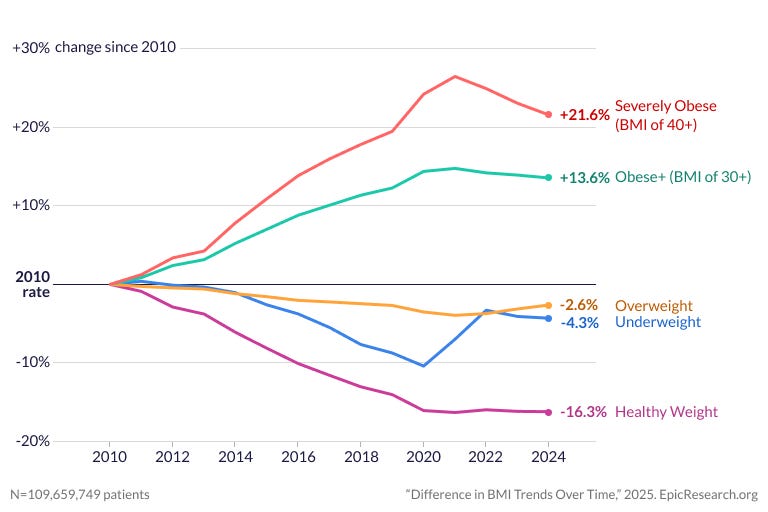
The results of this misguided advice are visible everywhere. Since the pyramid’s introduction, obesity and Type II diabetes have exploded.
In 2019, the combined direct and indirect costs of overweight and obesity were estimated at $705.7 billion, or 3.3% of U.S. GDP.
A 2016 study found that adults with obesity incurred $260.6 billion in excess medical costs.
Improving dietary patterns, even modestly, could save the U.S. tens of billions annually in healthcare expenses.
Behind these staggering numbers lies a simple truth: millions of Americans are suffering from preventable diseases caused largely by poor dietary guidance and the food system that supports it.
What the Government Knew
Was the USDA simply uninformed when it published the Food Pyramid? Evidence suggests otherwise. By the early 1990s, nutritional science already showed that:
Diets high in refined carbohydrates increase the risk of obesity, diabetes, and heart disease.
Unsaturated fats (olive oil, nuts, fish) are protective, not harmful.
Whole grains are healthier than refined ones, but neither should dominate the diet.
The 1988 Surgeon General’s Report on Nutrition and Health warned against excess sugar and refined grains. Internal USDA and Harvard researchers objected to lumping all fats together, calling the approach “nutritionally indefensible.”
Drafts of the original pyramid, written by USDA nutritionist Luise Light, emphasized whole foods, healthy fats, and limited refined starches. But industry lobbyists — particularly from the grain and dairy sectors — pushed back. Under pressure to protect agricultural interests, the USDA altered the pyramid to favor grain consumption.
Light later said her draft was “radically altered to serve the food industry rather than the consumer.” The result was a government-endorsed dietary plan that benefited Big Food while harming public health.
A Crime of Collusion
If we apply the same moral framework used to judge war crimes or civil rights violations, the Food Pyramid qualifies as a crime of neglect and collusion — a deliberate act of misinformation that endangered public health for profit.
Crime: Endorsing and promoting dietary recommendations known to be harmful.
Reason given: “Educating Americans about healthy eating.”
True reason: Protecting powerful agricultural and food industry interests.
Impact: A national epidemic of obesity, diabetes, and metabolic disease, costing trillions of dollars and countless lives.
The Rise of Ultra-Processed Food
While flawed guidelines were shaping school lunches and public policy, Big Food was busy inventing something even worse: ultra-processed foods. Emerging in the 1990s, these industrial formulations are made mostly from refined ingredients, oils, sugars, and chemical additives, with little to no whole food content. Examples include:
Soft drinks and energy drinks
Packaged snacks and sweets
Instant noodles, frozen meals, and fast food
Processed meats (hot dogs, nuggets)
Sweetened cereals and flavored yogurts
A typical fast-food burger, for example, may contain:
Mechanically separated meat or meat paste
Soy protein isolate or textured vegetable protein
Modified starches and chemical binders
Flavor enhancers like MSG or hydrolyzed proteins
Preservatives such as sodium nitrite
This is not real food — it’s an edible product engineered for profit.
Today, about 70% of foods sold in grocery stores are ultra-processed. These products are calorie-dense, nutritionally poor, and designed to be addictive. Their rise parallels the increase in chronic disease.
A Flawed System That Still Shapes Lives
Even as science and public opinion turned against the Food Pyramid, its legacy lived on. In 2011, the federal government replaced it with MyPlate, a new visual guide that promoted vegetables, fruits, lean protein, and healthy oils. The 2015–2020 Dietary Guidelines improved further by calling out added sugars and recommending that at least half of grains be whole.
But Problems Remain
First, these guidelines still assume a one-size-fits-all diet. Roughly 80% of Americans now suffer from some form of metabolic dysfunction — obesity, high blood pressure, or insulin resistance — and many would benefit from drastically reducing carbohydrate intake. Yet school lunch programs, which must comply with federal guidelines, cannot make such distinctions. Every student, healthy or not, is fed the same high-carb meals that may worsen disease.
Second, the government continues to enable Big Food by subsidizing grain and sugar production while allowing the marketing of ultra-processed products as “healthy” or “low fat.” The system that began with the Food Pyramid remains intact.
The Moral Reckoning
Looking back, it’s clear that the original Food Pyramid was not merely a scientific mistake — it was a policy-driven moral failure. The government, under pressure from industry, promoted a diet that it knew was nutritionally flawed. This policy helped create an epidemic of obesity and diabetes that still burdens the nation.
The Food Pyramid’s legacy isn’t measured in court cases or headlines, but in shortened lives, broken health, and staggering medical costs. It represents a betrayal of public trust every bit as grave as wartime atrocities or civil rights violations — slower, quieter, but just as deadly.
Now, for the first time in decades, there is renewed political will to confront Big Food’s influence. The current Secretary of Health and Human Services, Robert F. Kennedy Jr., has shown an interest in addressing the damage wrought by industrial food policy. The public should add their voice to that effort.
To fix America’s health crisis, we must first name its cause. The greatest crime of the 20th century was not committed with weapons or laws — it was committed with food.
Wrong Speak is a free-expression platform that allows varying viewpoints. All views expressed in this article are the author’s own.
