


Socialists are being nominated to run for House seats in the 2026 midterm elections and in other elections across the various states. The Democratic Socialists of America (DSA) reports that nearly 90 candidates are endorsed in the 2026 election cycle, including more than a dozen congressional candidates, with the remainder running for state legislatures, city councils, school boards, mayoralties, and other local offices.
National news organizations have identified about 10–15 prominent congressional and statewide candidates who openly use the label “socialist” or “democratic socialist.” Progressive Democrats, who are a much larger segment of the “Democratic big tent,” when combined with the socialists, create a formidable opposition to the Democratic establishment.
This is the largest wave of openly socialist candidates in the United States since the 1900–1920 period, the peak of the original Socialist movement. At that time, the Socialist Party of America regularly fielded hundreds to thousands of candidates for local, state, and federal office. Eugene V. Debs received nearly 1 million votes (about 6%) in the 1912 presidential election, and the party elected more than 1,000 local officials, dozens of state legislators, over 100 mayors, and two members of Congress. Milwaukee became famous for its long line of Socialist mayors.

The Socialist movement began to collapse after World War I for several reasons. After the Russian Revolution in 1917, people began to associate socialism with revolution and didn’t want America to go that far. The second reason was the Red Scare, starting in 1919, when anarchists organized labor strikes, carried out bombings, and sought to create economic instability.
The federal government arrested and deported hundreds of suspected radicals during the Palmer Raids. Socialist organizations came under intense surveillance and public suspicion. Other reasons for socialism’s wane include the ideological split in the Socialist Party, a period of emerging economic prosperity, and government measures put in place to address public grievances.
After World War II, the onset of the Cold War prevented socialists from regaining momentum, as the Soviet Union was widely regarded as America’s greatest threat. Being a socialist candidate, then, was a guaranteed way to lose an election. Socialism remained dormant until the late 1960s, when anti-establishment ideology began to take hold in academia. By the 1990s, progressives had firmly controlled higher education. Socialists participated in and supported cultural change but remained quiet because their ideology had little public acceptance.
Now, after a hundred years on the sidelines, dissatisfaction with the federal government has reopened the door to socialism. To understand how this could occur, you have to look at how the parties implement their ideologies.
Conservatives have no ideology. They believe in individualism, freedom, and our nation’s traditions. The conservative reaction to ineffective government is to seek a populist leader who will represent them. Trump was in the right place at the right time and assumed that role. Trump’s election was a message to the conservative establishment to fix the government.
On the Democratic side, the situation is very different. When Democrats become disenchanted with their politicians, they have a backup ideology to turn to: socialism. All they have to do is unleash the dormant communists and socialists and let them run.
Bernie Sanders’ popularity during the 2016 election reflected the onset of Democratic voter dissatisfaction, but his constituency was less than a critical mass, and Hilary Clinton rigged the primaries so he couldn’t compete.
What’s different now? We can see several factors at work. Trump’s election to a second term drives the left crazy and heightens frustration with their leaders. They see those leaders as fossilized establishment lackeys, old and out of touch.
The frustrations of Gen Z are also being expressed more strongly than before, as they are older and continue to struggle to achieve the American dream. They are the coddled generation whose helicopter parents did everything for them, and they want stuff. Still, the underlying issue, as with conservatives, is an ineffective government that needs fixing.
Conservatives rely on finding someone who will restructure the government in order to make it more responsive. Right now, Trump has the Republican establishment cowed. If you cross him, you get primaried.
Liberals have a more powerful tool to replace the establishment: a new kind of government that offers a permanent fix. Establishment Democrats are cowed in the face of the socialists, and they are afraid to criticize them. In their hearts, they know the socialists are unelectable, but they’re powerless to resist the progressive tide.
Here are new candidates for the midterms
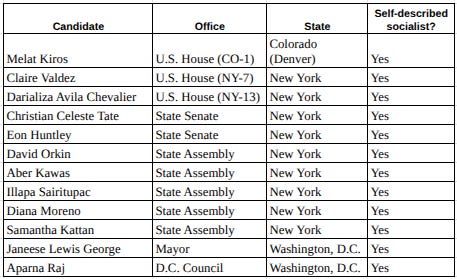
These candidates come from blue cities in blue states with high concentrations of college-educated liberals. Polls show 66% of Democrats have a favorable view of socialism. Some percentage of those people are more supportive of “Democratic Socialism” than the regime-change full socialism would bring to America.
Mamdani insists this is a national movement, but that isn’t true. We would have to see interest in electing socialists spread to more mainstream Democratic districts for his statement to be believable. Right now, socialist fervor is concentrated.
Let’s pause for a moment to review why socialism doesn’t work. The real world today is made up of democracies and dictatorships, with no socialist states functioning. The reason there are no socialist states is that people have never been willing to choose that kind of government.
People will not support governments that confiscate the fruits of their labor. In the modern world, human motivation comes from the desire to improve one’s life, so no one would be heard saying, “I work hard and wish to give away a large percentage of the benefits I accumulate to the government.”
To make socialism work, there must be an organizational entity at the top of the government that redistributes assets across the nation. People who have more will see their money taken and given to people who have less. That entity must operate as a dictatorial oligarchy, making redistribution decisions that cannot be questioned.
For that reason, it’s not hard to imagine that leadership entity turning into a functioning dictatorship at some point. The leaders would be kings, who reign for life. If they were subject to recall by voters, there would be no socialism, because voters would replace them with non-socialists.
Democratic Socialism is socialism behind the curtain. For years, Bernie Sanders has praised this ideology, citing the Nordic countries as successful examples, but a closer look shows they are, in fact, democracies with large welfare-state components. In Bernie’s telling, the American people will simply elect representatives who will implement the missing components of his welfare-state program: universal health care, guaranteed income, higher taxes on the wealthy, a higher minimum wage, free education, aggressive climate initiatives, and affordable housing.
The “Democratic” in democratic socialism assumes that people will elect candidates who will take their money, which is not going to happen. People vote for candidates they believe will protect their assets: keep taxes low, maintain a strong economy with good jobs, and protect them from both foreign and domestic threats.
The Democratic Party has a serious problem: its constituents’ dissatisfaction with the government has created an opening for the party’s left wing to pursue radical change. The establishment must defer to the left or face attack. The longer it defers, the less time remains to build an alternative case for the American people before the 2028 election.
My opinion is that the socialist movement in the Democratic Party can only be put down by voters rejecting the socialist as too radical and too far from the mainstream, not by the Democratic Party itself. The movement has to be allowed to play out. There is also another problem with the party. A divided party in 2028 could herald a Republican victory, putting the Democrats on the sidelines for eight more years.
It’s interesting to compare the 2028 election with the 1972 election, when Richard Nixon beat George McGovern in a landslide. McGovern was seen by many voters as too liberal because he proposed large cuts to defense spending, supported amnesty for many Vietnam draft evaders, and backed an ambitious expansion of social programs.
The Democratic Party was deeply divided, as many traditional Democratic leaders, labor unions, and Southern Democrats were lukewarm or openly hostile to McGovern and barely campaigned for him. Those same groups are in play this time.
Even though there is no single union position on socialism, most American unions do not identify as socialist. They believe in reaching their goals within the capitalist system. Some unions are more conservative and would never vote for socialist candidates.
The South is very different from what it was in 1972. Back then, it was socially conservative, often supportive of business and anti-communist and anti-socialist. Today’s Southerners are more moderate than those in the coastal states, unlikely to support Democratic Socialism, and more focused on healthcare, education, jobs, and infrastructure.
Socialists will be in trouble if they run in nationwide elections because they are too radical for most Americans. The elections this fall will be interesting, but the 2028 election is the real test of socialist momentum.
Wrong Speak is a free-expression platform that allows varying viewpoints. All views expressed in this article are the author’s own.

The problem with laying out the objective reality is that people don’t vote on objective reality; they vote on emotion. And as long as academia & media fuel the emotion of envy, socialism will continue its advance.
The realization - by some - that they have voted for their labor to be confiscated and given to layabouts either will come too late or will be rejected by ideologues, for reality is precisely what ideologues reject.
The left has been voting for labor confiscation since welfare began, as that’s what welfare … is. I find it difficult to see the advance of socialism slowed or stopped before it has achieved far wider implementation than it has, followed by total societal collapse, such as the USSR.
And the complete lack of opposition - and the GOPe is nothing if not that complete lack - will neither slow nor stop socialism’s advance.
> The second reason was the Red Scare, starting in 1919, when anarchists organized labor strikes, carried out bombings, and sought to create economic instability.
Given the following:
> To make socialism work, there must be an organizational entity at the top of the government that redistributes assets across the nation. People who have more will see their money taken and given to people who have less. That entity must operate as a dictatorial oligarchy, making redistribution decisions that cannot be questioned.
and speaking as a "market anarchist" myself, I truly have no idea how anyone who favors socialism can think of themselves as "anarchist" in philosophy, or why anyone else would grant them the title either.