


I ran across this quote the other day:
Christmas is the day that holds all time together.
-- Alexander Smith
It is a very Christian sentiment, and it got me thinking about how much society has changed over the years and about what it is that holds a society together. It isn’t surprising that this quote is unapologetically Christian. Smith was a Scottish poet who lived from 1829 to 1867.
He lived in a different world. A Christian world. At least with respect to the West.
The foundation of Western society, the common belief that held society together, was Christianity. Sure, there were different variants, often in conflict with each other, but our laws, morals, and social norms were based upon a common set of values which were largely taken from Christianity and the Bible. At least broadly speaking. Christianity wasn’t the entirety of Western civilization, but it supplied a shared moral framework within which those other institutions operated.

What is our common denominator today? Is it still Christianity? The table below shows that the percentage of people claiming to be Christian has declined significantly and, in some locations, it has declined to such an extent that Christianity is now a minority in some Western countries.
The decline in Western religiosity is a complicated topic with many mutually reinforcing changes. Science gradually replaced religion as the West’s primary explanatory authority for the natural world. Rising existential security reduced the need to explain things that once made life extremely precarious: infant mortality, famine, disease, premature death, war. Religion, which was once an important factor in a person’s identity, became just another choice a person could make. And the list goes on.
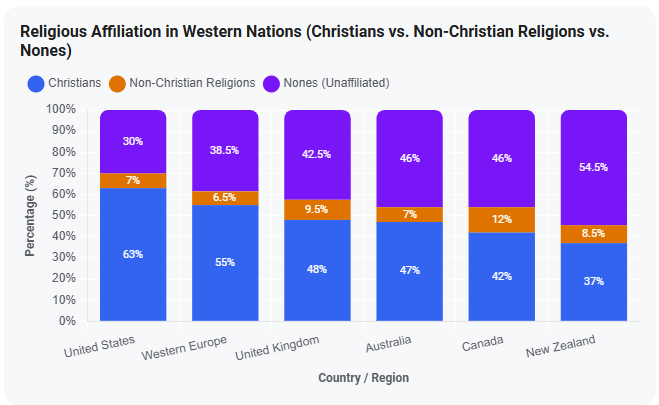
However, we don’t need to explain why things changed to recognize that they did—and that Christianity can no longer be considered our common belief system. As much as many of us may wish otherwise, it is not the glue that binds us together.
So, if Christianity isn’t holding Western countries together, what is? What has replaced Christianity as the bedrock of Western society?
“Liberal democracy?”
That is certainly something all Western countries have in common, but you can’t hold a society together with something so simple as “I have rights.” Rights conflict, so are as likely to cause conflict as to prevent it.
“Freedom” doesn’t work either, as it only unites us when it is threatened. And even then, it is only if we all agree what freedom means. And we don’t.
Many have suggested that “civility is the glue that holds society together.” It’s certainly a catchy quote. However, civility is less a glue than it is a means to avoid conflict. I can be polite to people in a foreign country without needing to have anything in common with them.
The longer I think about this and the deeper I dig trying to find bedrock, the more worried I become. I fear that over the last 50 years Western society has slowly replaced Christianity with “multiculturalism” and “tolerance,” and if I’m right, that’s a big problem.
“Multiculturalism,” as it is currently practiced in the West, requires adherents to believe one of two things, each wrong in its own way. The first requires supporters to believe that culture and values are somehow separate. That people from China, India, or Iran are just Westerners who dress differently, speak a different language, and eat different types of food. The second belief, which at least pays lip service to the existence of significant differences, assumes that cultures can coexist without shared values.
Both assumptions are seriously flawed. Culture and values are not distinct; they overlap. Different cultures may share some similar values, but they do not share them all. How different cultures are from each other greatly influences how likely it is that they can coexist. Believing otherwise is what has contributed to much of the strife resulting from mass immigration.
“Perhaps,” you might say, “but certainly tolerance is a good thing, right?”
Sure, but “live and let live” is hardly a unifying creed. Tolerance may be a virtue, but it’s a negative virtue; it doesn’t tell us what to do, but rather what not to do. If anything, it promotes the fragmentation of society by promoting, or at least tolerating, the creation of sub-communities that have little in common other than some shared infrastructure and the right to vote.
I fear that in our efforts to “live and let live,” to believe that everyone is essentially the same and wants essentially the same things, we have planted the seeds of our own destruction.
My question to you is this: can a society survive indefinitely without a shared conception of what is good?
About the Author
Phil is a freelance writer, Canadian Navy veteran, and classical liberal. He has lived and worked in both Canada and the United States and currently resides in Vancouver, British Columbia, where he writes on politics, individual rights, free speech, and whatever else catches his fancy.
📰 Hoist the Black Flag — politics, rights, and free speech
😄 Schrödinger’s Chicken — because sometimes you just need to laugh
If you enjoyed this piece
The single best thing you can do is hit the like button — it costs nothing and tells the algorithm this is worth sharing. After that, a restack puts it in front of readers who might never have found it otherwise.
If you’d like to support the writing directly, subscribing or buying a coffee goes a long way. Either way, thank you for reading — it genuinely matters.
Wrong Speak is a free-expression platform that allows varying viewpoints. All views expressed in this article are the author’s own.
"can a society survive indefinitely without a shared conception of what is good?" Probably not. We just don't know where to draw the line, when to stop as humans - everyone has a different opinion and really, we can only tolerate one another's view to an extent. So many things that started as compassion for fellow humans turned into very slippery slopes - assisted suicide, gay rights, reproductive rights, "free love", etc. As a non-Christian, I wouldn't be comfortable with Christianity as a shared conception. Not that we are taking a poll here, but my vote for shared values would be the Noahide Laws.
Time did not start in the year A.D. 1, so Smith's phrasing "holding ALL time together" is obviously intended to refer to pre-Christian practices in addition to Christian tradition itself.
This also explains why Smith chooses Christmas specifically, rather than the actual holiest day of the Christian year (= Easter Sunday). Unlike Easter Sunday, which is solely and entirely Christian, Christmas has close ties to ancestral pagan faiths especially in terms of its placement on the calendar.
Jesus, after all, was born in late spring—this is straightforward to prove from the Biblical narratives. (Shepherds lying in the fields all night keeping watch means that it was lambing season, which is mid- to late spring; and Luke 2:1-4 says a Roman census was being taken at the time, which means late spring to early summer.)
But Christmas is in midwinter... because earlier, ancestral new-year celebrations (originally from pagan pre-Christian societies) marked the winter solstice. Early Christians turned the winter solstice into their Christmas celebration, so that they would continue to have that celebration in common with other groups who lived in the same areas. (They also kept the symbolism of a tree to represent new life from the old pagan traditions; this became our modern Christmas tree.)