


Israel is truly an amazing place with its history, both religious and political, being an important part of the history of Western society for the past 2000 years. Israel’s establishment as a nation in 1948 and its subsequent battle for survival are also significant aspects of 20th and 21st-century Western history. Today, Israel and its partner, the United States, are in the midst of a war to end 47 years of Iranian efforts to terrorize the world and destroy the Jewish people.
I traveled to Israel in 1981 on a business trip, stopping in Paris on the way back. It was a two-week journey that began the last week of December and ended in early January 1982. I had just left academia and moved into the private sector when a friend called to tell me he had recommended me for a consulting assignment in Israel. He was acting as a consultant for the State Department and was not available for the assignment.
The Israeli Health Ministry had asked the State Department to send someone to advise them on IT deployment and network communications. It was a once-in-a-lifetime opportunity, and I jumped at it even though I knew nothing about the project.

The year 1981 saw the Iran-Iraq War raging and increasing unrest in Lebanon. Israel attacked Lebanon in 1982, marking the beginning of the Lebanon War. Israel’s attack was launched to destroy the PLO (Palestinian Liberation Organization) fighters operating there. Then in 1983, the American Barracks in Beirut were bombed, and 241 Americans were killed. I knew what was going on in the Middle East, but I wasn’t concerned that I would be harmed.
I flew from Detroit to Frankfurt as the first leg, then on to Tel Aviv. The first leg was uneventful, but our departure from Frankfurt was an experience I will never forget. Instead of waiting in the gate area, the other passengers and I were taken to a private room with our luggage.
A team of airport employees was there to open and search the bags. After that was completed, we sat and waited for a bus to take us to our plane. After we boarded it, the bus took us to a remote part of the airport. There our Lufthansa plane sat, by itself, encircled by a group of soldiers armed with automatic weapons. Seeing those soldiers made the Middle East feel like a hotbed for me.
The plane departed Frankfurt on time for our four-hour flight. During the flight, I kept looking around, trying to identify the Mossad agents who were undoubtedly on the plane. They did a good job of disguising themselves. The flight was uneventful, and we arrived in Tel Aviv on time. Walking down the stairway, I noticed serious-looking men at the bottom. I guessed they were Mossad agents who had memorized the faces of every terrorist in the Middle East, and I appreciated their thoroughness.
I spent three or four days in Tel-Aviv, ushered around by health ministry personnel. The main event was a visit to Sheba Hospital, the city’s largest medical facility. We looked at the computer room and discussed how the equipment was being utilized.
That was when I was told of the reason for my visit. The Israeli hospitals at that time operated as isolated islands of information processing. The National Health Ministry saw this as a problem due to its obvious inefficiency. They wanted to consolidate their data and share it across the different locations.
When I wasn’t busy with Health ministry officials, I was on my own, which meant doing some exploring. I visited the beachfront area and had dinner there. Tel-Aviv appeared to be a modern version of Jerusalem.
On my last day in Tel Aviv, I was given a tour of the northern part of Israel, including Haifa, about an hour to the north. While there, I was taken to a place where we could observe the Golan Heights, a strategically important plateau of land, which was occupied by the Israelis in 1981. Before the Six-Day War in 1967, Syrians had used the heights to attack the north of Israel with artillery, so its occupation was strategically important to Israel.
The next day, I was driven to Jerusalem. My time there included an immersion in the region’s history. I visited Bethlehem, Jericho, and all the holy sites in the city.
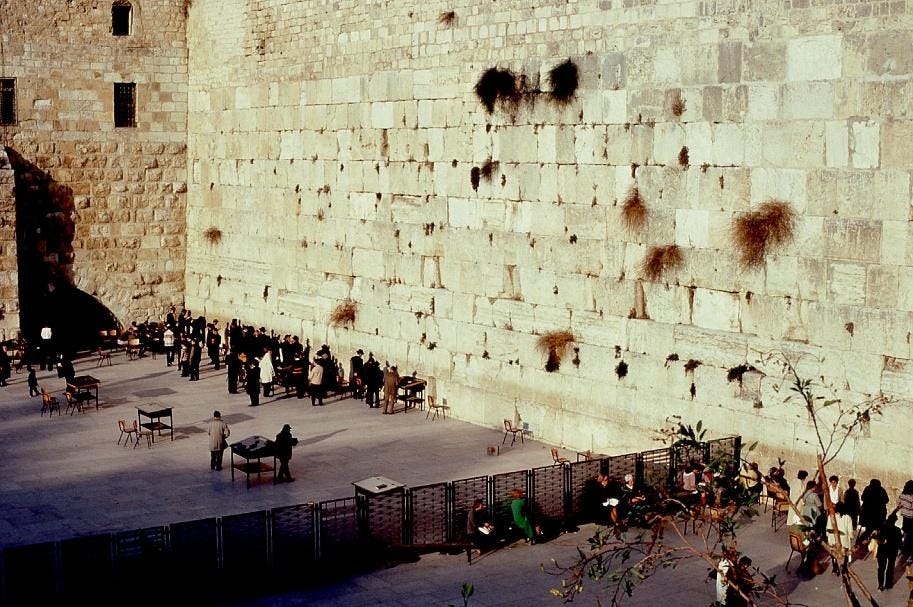
It was fascinating to walk through the old walled city and imagine the events that took place there. I was taken on a tour of the famous Hadassah Hospital, probably the best-known medical facility in Israel. On New Year’s Eve, I sat in the hotel lobby for a while watching TV. It was an odd experience because there were no festivities. The Western New Year means nothing in Israel, which celebrates Rosh Hashanah in September.
On the last day, I was invited to a senior staff meeting at the Health Ministry to share my thoughts on their concerns. That meeting was an eye-opening experience, given the contrast with the kind of meetings we have in the States. All of the attendees were dressed casually, and the table where we sat was filled with bottles of various juices, water, and fruit.
During the meeting, the participants argued and interrupted one another, each seeking to prove that their ideas offered the best solution to the problem. It was like a big free-for-all. They may have expected me to join the melee, but it was hard for me to get a word in edgewise.
I’m afraid I was a disappointment to them because I couldn’t offer a magic solution. The internet did not exist, and data processing sites had to rely on phone lines to transfer information. The Israelis told me their phone systems were unreliable and subject to frequent disruptions.
Without an ironclad method of sending data, they couldn’t be sure of the data integrity at the other end. I told them that they had to continue with the “islands of data” model until their phone systems became more reliable.
I departed Israel for a weekend in Paris, which I had never seen. It was snowy and cold there. I visited the Eiffel Tower and Notre Dame, climbing up to the roof of the great cathedral.

The trip had a profound impact on my understanding of Israel and how it has to deal with threats every day. I will never temper my admiration for a people who have had their traditional homeland returned to them and ferociously defended it against their adversaries in the Middle East. Every Israeli would die for their homeland if the need arose, which is why all eligible young people are required to serve in the Israeli Defense Force (IDF).
The zeal of the Jewish people matches that of their ancestors who fought the Romans. In 70 CE, a Jewish militia attacked the Roman fortress at Masada and killed every Roman soldier in retribution for the Roman burning of Jerusalem. It took the Romans two years to prepare for an assault to retake the impregnable rock. When they finally broke through during the final assault, all the Jews had committed suicide.
Today, in the United States, Israel is being attacked from the left and right. To the left, they are oppressors of the Muslim people, who must be condemned. To the right, they are an unnecessary distraction from the implementation of an America First, nationalist identity in America.
The suffering of the Jews over the last two thousand years and their continued resilience deserve our respect and support, not our condemnation.
Wrong Speak is a free-expression platform that allows varying viewpoints. All views expressed in this article are the author’s own.

Thanks for a nice read. I am not Jewish but I also like what I've seen of Israel and I like the friendliness and spunk of the people I've met there.
After reading several of your past posts and seeing the same pattern, I started to wonder if you were contracted to write such pieces. At least in my mind, thanks to this one, you've confirmed it. Thanks, good to know.