


In the 1988 movie “Big”, Tom Hanks plays a 12-year-old named Josh, who is frustrated because he is stuck at an age when his parents won’t let him make his own decisions. Josh’s frustration peaks when he takes a girl to an amusement park and is denied access to a ride because he doesn’t meet the height requirements. Josh then notices the Make-A-Wish booth with a bearded mechanical man inside the glass.
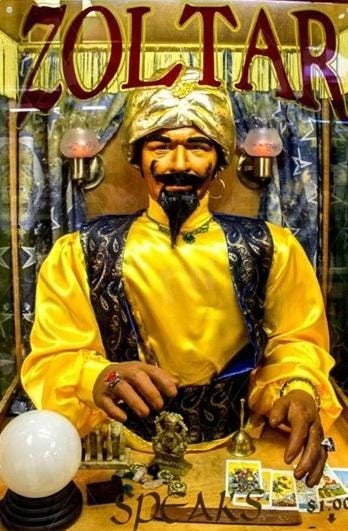
Josh puts a dollar into the machine and makes a wish to be big.
Nothing happens, and Josh goes home disappointed. The next morning, he wakes up, looks in the mirror, and sees that he has become a 30-year-old man. Frightened by this development, Josh goes back to the amusement park, only to find that the fortune-telling booth is gone. The movie goes on to explore Josh’s adjustment to adulthood and the funny situations he gets himself in. At the end, he becomes a boy again, understanding that adulthood might not be all that it seems.
Fast forward to 2025, and we have Zohran replacing Zoltar. Zohran Mamdani, a New York state assemblyman since 2021, became a public figure in May 2025 when he announced his run for New York City mayor. He won the June 24th Democratic primary, defeating Andrew Cuomo and Eric Adams, and was elected mayor that November by a wide margin.
His rapid rise shows how the “charisma bug” still thrives in American politics, particularly on the left. Charismatic figures—intelligent, idealistic, and articulate—embody change and compassion. They project confidence, and their followers often conflate charm with competence. The Democratic Party, historically drawn to such personalities, elevates them quickly.

Bill Clinton’s charm propelled him from Arkansas governor to national prominence. He balanced charisma with moderation, which made him effective. Barack Obama followed—a leader with little executive experience but immense personal appeal. His charisma carried him to the presidency and still sustains his popularity. Pete Buttigieg, with elite credentials and poise, was another media favorite, though he struggled to win broad support—especially among Black voters. Now comes Zohran Mamdani, whose ideology is more openly socialist than any of his predecessors.
Charisma and Power
Sociologist Max Weber identified three forms of political authority: hereditary, charismatic, and rational-legal. The United States operates on the rational-legal model—power derived from established laws and elections. Charismatic authority, by contrast, rests on personal magnetism and emotional appeal. Its power is intense but fleeting. When the leader leaves, the connection dissolves. The second danger is institutionalization: over time, the magic fades, and followers expect results that charisma alone cannot deliver.
The Democratic Party faces this problem today. Since 2010, it has struggled to create a sustainable populist movement. Republicans have claimed traditional Democratic issues—middle-class prosperity and family values—while Democrats have pivoted toward Silicon Valley and social justice causes. The party’s new populism leans socialist, especially appealing to younger voters frustrated by economic stagnation, high housing costs, and lack of opportunity. Gen Z’s cynicism about capitalism and government drives them to seek “something different,” and socialism, at least rhetorically, offers that alternative.
Bernie Sanders has been the face of that movement since 2016, when he challenged Hillary Clinton. Many of his supporters believe the Democratic establishment sabotaged his campaign, confirming their distrust of party elites. Sanders now sees Zohran Mamdani’s victory as the possible rebirth of the socialist dream.
The Reality Test
Mamdani’s platform includes government-run grocery stores, free mass transit, and universal day care—funded by a 2% wealth tax. The plan has energized progressives but alarmed moderates, including New York’s Democratic governor, who faces reelection next year. Without her support, Mamdani’s agenda may stall. If the wealth tax fails to pass, his key programs will likely collapse.
Democrats have had success electing socialists in deep-blue districts, but these local experiments often reveal socialism’s practical limits. While such initiatives may inspire enthusiasm, they rarely scale beyond city or state governments. At larger levels, the ideology collides with fiscal and political reality. For many Americans, socialism remains too radical to trust.
Charisma, in this sense, is dangerous. It fosters emotional loyalty instead of rational judgment. Voters entranced by style overlook competence and feasibility. When the glow fades, disappointment sets in. History repeatedly shows this pattern: the charismatic promise outpaces the practical outcome.
Why Conservatives Resist Charisma
Interestingly, conservatives tend to be less susceptible to charisma. Their political psychology and value system favor structure over emotion. Several factors explain this difference.
Preference for Rational-Legal Authority: Conservatives emphasize stability, hierarchy, and the rule of law. They trust institutions and tradition more than personality. Charismatic leadership appears volatile—a risk to order and constitutional norms.
Skepticism of Emotional Appeal: Right-leaning voters value logic, consistency, and realism. Emotional persuasion, a hallmark of charismatic politics, can feel manipulative. They prefer policy grounded in evidence and predictability rather than passion or moral crusades.
Fear of Authoritarianism: Conservatives associate charismatic power with self-aggrandizing leaders who centralize authority. They prize humility and accountability, qualities easily eclipsed when charisma dominates politics.
Desire for Stability: Research suggests conservatives perceive the world as more threatening and uncertain, leading them to prioritize safety and predictability. Radical change—even when wrapped in optimism—feels destabilizing. A charismatic disruptor who promises transformation can appear dangerous rather than inspiring.
Individualism Over Collectivism: Conservatives celebrate individual effort and self-reliance. Charismatic leaders often promote collective identity and ideological unity, which can clash with conservative values emphasizing personal responsibility.
Thus, while Democrats elevate charismatic figures like Obama, Buttigieg, and Mamdani, conservatives prefer leaders who embody competence and steadiness. This contrast explains why charismatic movements tend to flourish on the left: they speak to emotional yearning for moral renewal, while the right remains anchored in institutional trust.
Zohran’s Challenge
Zohran’s mayoralty will test whether charisma can translate into results. His youthful energy and moral confidence resonate with progressives, but his policies face economic and political roadblocks. Free transit and public grocery stores sound appealing but require massive funding and logistical control. Without private-sector cooperation, such programs risk inefficiency or failure.
The broader problem for socialists is that governing requires trade-offs. Idealism must yield to pragmatism. Charisma can inspire movements, but systems demand management, budgets, and compromise. The Democratic Party’s socialist wing often overlooks this reality. Their energy wins elections, but implementation exposes the limits of emotional politics.
If Zohran’s programs falter, it may disillusion a generation of idealists. Yet history suggests that disappointment won’t kill the movement—only redirect it. Each failure becomes a reason to “try socialism again,” this time “the right way.” The faith endures because it’s emotional, not empirical.
The Charisma Trap
Charisma magnifies belief. It creates a feeling of inevitability, as though progress is guaranteed by moral virtue alone. But when charisma overshadows competence, leaders lose accountability. Followers excuse failure because they identify emotionally with the leader’s purpose. That’s how idealism turns into dogma.
Conservatives are right to view charisma warily, but they are not immune to it. Every movement eventually elevates someone larger than life. The challenge is ensuring that emotional energy strengthens institutions rather than undermines them. For any democracy, the danger zone begins when people stop asking, “Can this person govern?” and start believing, “Only this person can save us.”
Zohran Mamdani’s victory offers a glimpse into the Democratic Party’s future—a new wave of charismatic, ideologically bold candidates who promise transformation. Whether they deliver is another story. The coming years will reveal whether charisma can survive contact with reality.
New York City, once the testing ground for American capitalism, may now become an experiment in modern socialism. If history is a guide, expectations will exceed results. But even when dreams collapse, charisma has a way of reviving them. That, perhaps, is its most seductive and dangerous quality.
Wrong Speak is a free-expression platform that allows varying viewpoints. All views expressed in this article are the author’s own.

Solid breakdown of how charisma can become a substitute for actual policy competence. The Weber framing here gets at somethign really interesting: when we're emotionally invested in a leader, we stop asking if they can actually deliver. I saw this play out locally where a super charsimatic city council member won big but couldn't get budget approvals through. Once idealism meets fiscal reality, the magic fades fast.