


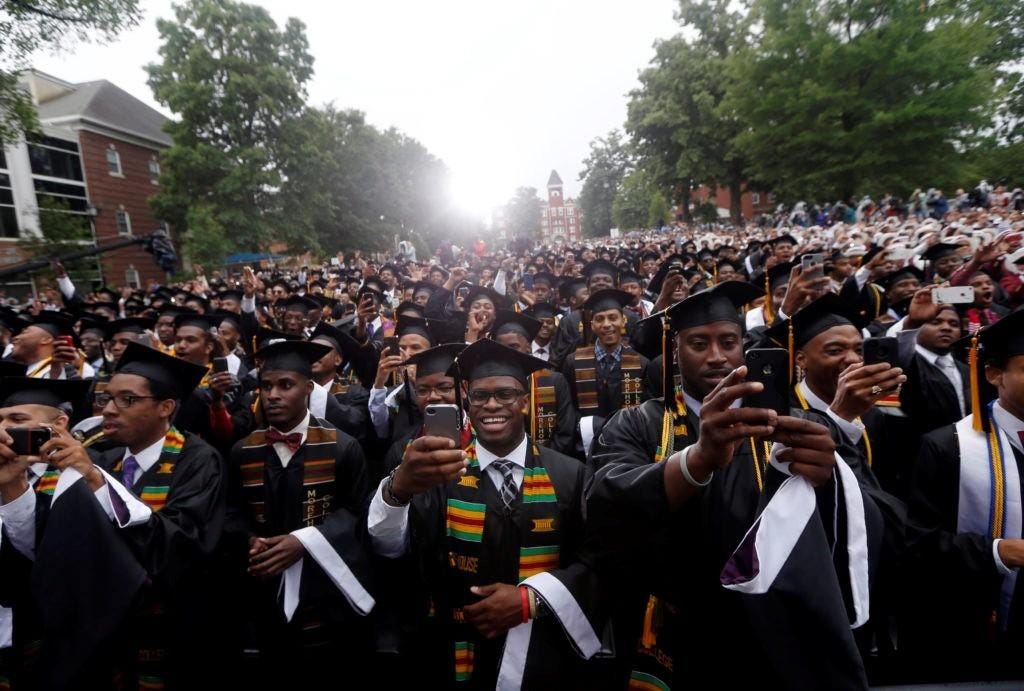
You flip on the television at night, exhausted from the day, and there it is again. Another segment on FOX News about “inner-city chaos” and skyrocketing crime. CNN rolls out experts decrying systemic barriers that keep Black men locked in cycles of poverty and punishment. On Newsmax or OAN, the tone is often even harsher, conveying the same message of danger, failure, and inner-city crime.
Scroll through social media (X, Facebook, TikTok, Truth Social, and even Instagram), and the algorithm serves up an endless buffet of outrage clips, fights, viral memes, and cherry-picked tragedies exploiting black violence and crime. Black men in America, the story goes, are either victims or villains. Rarely anything in between. This is what so many depict now as “Black Culture.”
But here’s a number that never makes the chyron: there are over 400,000- 500,000 more Black men in college than in prison. Let that sink in. Not a talking point. Not a spin. Data from the National Center for Education Statistics and the Bureau of Justice Statistics has shown this reality for years.

Back in 2009, roughly 1.4 million Black men were enrolled in postsecondary programs, while about 840,000 were behind bars. The gap has fluctuated with enrollment trends and declining incarceration rates, but the fundamental truth remains: more Black men are hitting the books than the cell block. And yet you’d never know it from the nightly news or your feed.
One of the main reasons why this isn’t common knowledge is that outrage pays, while nuance and boring truth don’t. Media outlets on both the left and right run-on engagement. Fear keeps eyes glued. Hope doesn’t trend.
A police encounter gone wrong in a major city is prime-time and will headline news cycles for a week, if not more. A young Black man graduating from Howard, Morehouse, Tuskegee, the University of Michigan, Clemson, or Texas Tech with a degree and landing a good job or starting an innovative business will hardly ever get mentioned unless he is a star athlete. It doesn’t fit the script.
For progressive networks, acknowledging educational gains might undercut the narrative of perpetual systemic failure. For conservative ones, highlighting Black success stories risks softening the tough-on-crime message that resonates with their base. Social media algorithms are engineered to hack your dopamine, feeding on outrage, anxiety, and tribalism to keep you hooked. Statistics about Black college enrollment barely get mentioned, and when they do, it gets buried under the latest culture-war land mine.
This isn’t a conspiracy. It’s business. Cable news ratings soar during racial unrest. Social media companies profit when tribal users contribute to their echo chambers. Politicians on both sides raise money off the divide. This has led to a distorted mirror held up to Black America that reflects only the broken pieces.
I’m not saying these problems don’t exist. They definitely do. Black men are still overrepresented in the criminal justice system relative to their share of the population. Poverty, fatherlessness, and failing schools in some neighborhoods are real problems. Crime statistics paint a horrific and sad picture of reality for many Black Americans, and ignoring them helps no one. But the same honesty demands we acknowledge the other side of the ledger.
Incarceration rates for Black Americans have dropped sharply since the peak of the war on drugs. College enrollment, despite recent dips among Black men specifically, still outpaces imprisonment. Black-owned businesses are growing faster than the national average in many sectors. Homeownership rates have ticked up over the past two decades.
These aren’t miracles. They’re the product of individual grit, family sacrifice, mentorship, community churches, athletic organizations, HBCUs, and yes, policy shifts that reduced mandatory minimums for nonviolent offenses. Yet the coverage gap is glaring.
Search any major outlet’s archives for stories on Black male college graduation rates. You’ll find a handful that are usually tied to some crisis or protest. Now search for stories on prison populations, bail reform failures, or urban violence. You’ll come across page after page and link after link. The imbalance isn’t accidental. It’s purposeful curation. Media gatekeepers decide what “matters,” and positive Black achievement rarely clears the bar unless it serves a larger ideological point.
I remember talking to a friend. He is a Black father of two sons. He put it bluntly: “They want us mad, not motivated.” He wasn’t wrong. When every headline screams crisis, young men internalize it. They see the world as rigged against them before they’ve even tried.
That’s the quiet poison of selective storytelling. It doesn’t just inform; it shapes expectations. Tell a generation that prison is their destiny, and some will live down to it. Show them the thousands walking across stages in caps and gowns every spring, many of whom are the first in their families, and you plant a different seed.
Don’t get me wrong. I’m not calling for feel-good propaganda either. Truth requires both the bad and the good. The incarceration rate for Black men born in 2001 is still far too high. Some estimates have shown that one in five Black men born in 2001 is expected to serve time in prison during their lifetime. That’s unacceptable. But so is pretending that the needle hasn’t moved.
Since the early 1990s, Black male college enrollment has exploded before recent headwinds. HBCUs, once written off, have produced leaders in every field. Black men are earning degrees in engineering, business, and health sciences at rates their fathers could only dream of. These aren’t exceptions. They’re patterns hidden in plain sight.
This matters beyond Black America. Every group gets the selective treatment. Immigrants are either all criminals or all saints, depending on the outlet’s bias. Rural whites are either salt-of-the-earth or dumb rednecks. The game is the same: simplify, polarize, and repeat. But when it comes to Black men, the stakes feel higher because the stereotypes have such deep roots, and there is very little “either” for us. The “thug” trope sells papers. The “scholar” doesn’t. Yet many scholars are out there. Many of them are quietly rewriting the story one diploma at a time.
Imagine if the media treated this like the achievement it is. Front-page features on first-generation graduates. Profiles of Black men mentoring at-risk youth while finishing night classes. Data-driven segments on how family structure, school choice, and personal agency drive outcomes more than pundits admit. Ratings might dip initially. But trust could be rebuilt. Viewers might feel something besides anger and prejudice, maybe even hope.
Until that happens, the responsibility falls on parents, teachers, pastors, uncles, coaches, bosses, mentors, and anyone with influence. We all have to be responsible and take accountability. Tell the young men in your life the whole truth. Yes, the world can be unfair. Yes, some systems need fixing. But no, prison isn’t inevitable. College, trade school, and/or entrepreneurship paths are possible and increasingly traveled. Data proves it.
The next time you catch yourself doom-scrolling or glued to the 24-hour outrage machine, pause. Ask: What aren’t they telling me? Then go find out. The numbers don’t lie, even when the headlines do. There are more Black men in lecture halls than prison yards.
That’s not spin. It’s reality. And it’s time the rest of the country heard it-unfiltered, untwisted, and unapologetic. Because propaganda makes for lousy education. Truth, messy as it is, builds better futures.
Wrong Speak is a free-expression platform that allows varying viewpoints. All views expressed in this article are the author’s own.

I didn't know this fact, and I'm happy to learn of it. Yes, chaos pays - in more ways than one. What are the stats on Black men getting married and having kids? I have a feeling that stat is turning around. This may sound odd, but when I noticed some years ago black men doting on their dogs on walks, I saw it as a yearning to start a family. This is in contrast to crazy white women (including young women) pushing their dogs in strollers. I don't think that is leading to anything positive.
Some of us have been on this path our entire lives and we were labeled a sellout for it.