


Bernie Sanders is 84 years old. A lifelong socialist, he has realized that America will never be a socialist country. As an ideological replacement, Bernie has been peddling a big lie for at least ten years, hoping we don’t look under the covers.
He preaches that America should adopt a Scandinavian-style government because it would allow us to provide cradle-to-grave welfare benefits for the entire population, including medical care, social security, free education, and generous time-off policies. If it works in Sweden, it will work here.

The lie part is the mischaracterization of Scandinavian governments, making them appear to be something they aren’t. Yes, they have sophisticated welfare state programs, but socialism is not part of their system. In this article, I will provide an analysis of the Swedish system by assembling Swedish income and tax data and comparing them with those in the United States.
Sweden experimented with socialism in the 1970s and early 1980s, increasing government control and using taxes and regulations to expand its welfare state. While the country initially experienced prosperity, this era of socialist policies was marked by a decline in economic growth, a loss of international competitiveness, and a public backlash that led to a return to market-based reforms in the 1980s. Sweden’s partial experiment with socialism failed miserably.
Today, Sweden maintains a robust welfare state while implementing free-market reforms, making it a mixed economy. Bernie calls Sweden a Democratic Socialist political system, which it is not.
Democratic socialism is a political philosophy that supports political democracy within a socially owned economy, with a particular emphasis on economic democracy, workplace democracy, and workers’ self-management. It can also be characterized as an alternative form of a decentralized planned socialist economy. Democratic socialists argue that capitalism is inherently incompatible with the values of freedom, equality, and solidarity and that these ideals can only be achieved through the implementation of a socialist society.
Sweden does not have a government-managed economy. It has a market economy. It does not have worker self-management or a planned economy. Sweden is a representative democracy with advanced welfare state programs.
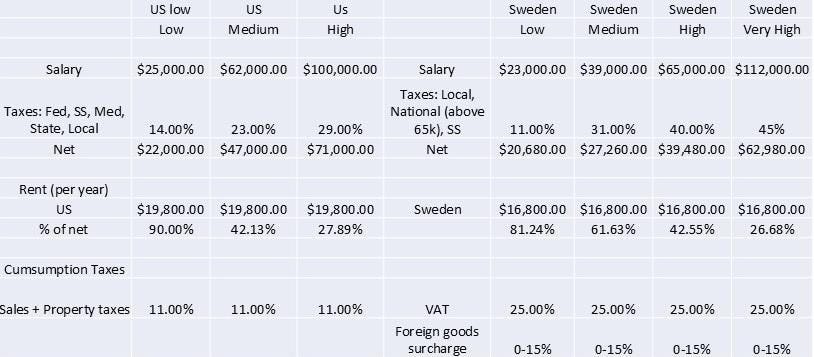
The columns are divided by income group for both countries. Swedish incomes are lower than those in the United States. As the chart shows, a medium income in the US is a high income in Sweden. Swedish income taxes are much higher than those in the United States. Swedes pay a 32% municipal tax and a national income tax on income above $65,000. They also pay Social Security taxes. Take-home pay in Sweden is lower than in the US due to high taxes and lower gross wages. Rents are higher in the US, but the impact of rent on lower take-home pay in Sweden is greater.
Sweden has much higher consumption taxes than the US. Americans pay about 11% in property and sales taxes. Sweden has a universal 25% VAT tax on all purchases. In addition, the purchase of goods not made in Sweden is subject to a foreign goods surcharge of up to 15%. For example, a MacBook costs about $ 3,000 in the US. In Sweden, the price of a MacBook is $ 4,000.
The United States could have a welfare state like Sweden if the government doubled everyone’s taxes. How would that go over?
There is no free lunch. You don’t get welfare state programs without someone paying the bill. The payees in Sweden are the public.
Bernie’s socialist dream will always be a dream. In a market-based economy, people pay for the government. When you implement socialism, an authoritarian government places limits on consumption, lowering the standard of living for the people. As we saw in Sweden in the 1970s, it also lowers global competitiveness because the government is incapable of managing the economy efficiently.
The Swedish socialist movement came to a halt in 1983. The government had created a program called “wage-earner funds,” designed to funnel corporate profits into funds controlled by labor unions. The plan was to build up the funds and, at some point, have the unions take control of the corporations. Corporations and moderate politicians strongly opposed this plan. A demonstration of 100,000 people took place in Stockholm on October 4, 1983. As a result of the protest, the wage-earner fund concept was implemented in a watered-down form in 1984 and then finally abolished in 1992.
Swedish corporations recognized that their country had become less competitive in the world marketplace due to the impact of socialist programs, and they were unwilling to take the next step.
We don’t want to be Sweden, despite Bernie’s dreams. He should realize that it’s hard to disguise the failures of socialism with lies because the data will always speak the truth.
Wrong Speak is a free-expression platform that allows varying viewpoints. All views expressed in this article are the author’s own.
